Discordianism Decompiled · Book Two · Chapter 2 of 6
The New Pentabarf
(Pentabarf v2025.1 - Now with More Barf)
THE NEW PENTABARF
(Pentabarf v2025.1 - Now with More Barf)
The original Pentabarf (from the Principia Discordia, circa 1960s) served us well. But times have changed. We have iPhones now. We have existential dread about climate change. We have productivity culture that makes Calvinist work ethic look chill.
It's time for an update.
These are not replacements for the original Pentabarf. They exist alongside it, contradicting it, complementing it, confusing it.
THE FIVE COMMANDMENTS (Which Are Actually Suggestions) (But Also Commandments)
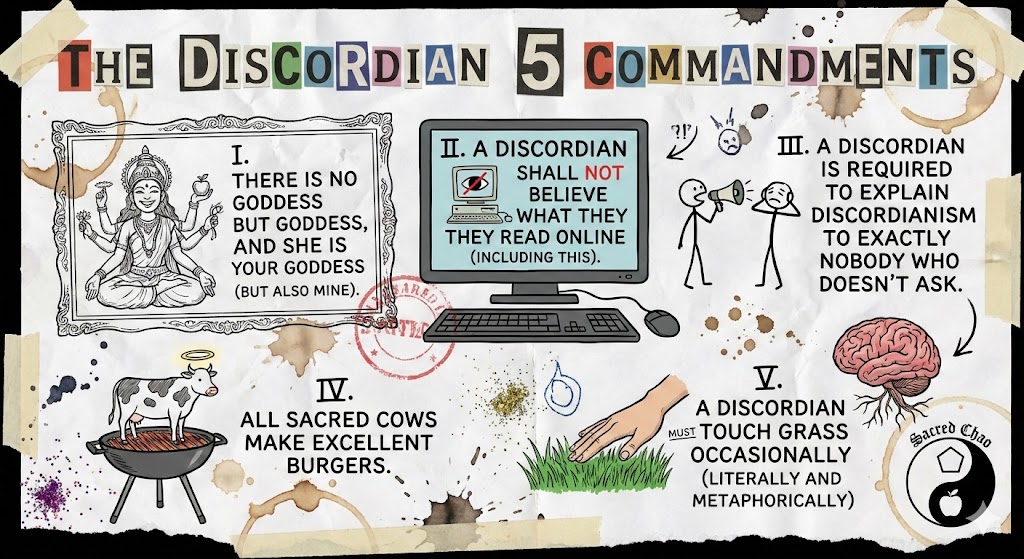
COMMANDMENT ONE: There Is No Goddess But Goddess, And She Is Your Goddess (But Also Mine)
The Teaching:
Eris is your goddess. Personal. Specific to you. Your chaos, your discord, your particular brand of questioning authority.
Eris is also my goddess. Personal. Specific to me. My chaos, my discord, my particular brand of questioning authority.
These two facts contradict.
Your Eris and my Eris are different goddesses.
But they're the same goddess.
But they're different.
This is working as intended.
Individual Experience of Chaos Is Valid
Your experience of chaos is real and true.
When you feel disorder in your life, that's real chaos.
When you question the systems around you, that's real discord.
When you feel like nothing makes sense, that's real Eris.
No one can tell you your chaos isn't real.
No one can tell you you're not experiencing what you're experiencing.
Your relationship with Eris is yours alone.
Collective Experience of Chaos Is Also Valid
But also, we're all experiencing chaos together.
The disorder you feel is the same disorder I feel.
The systems we're questioning are the same systems.
The goddess we serve is the same goddess.
We are in this together.
We are a community of chaos.
We share the same Eris.
They Contradict
Yes.
Your Eris is uniquely yours AND we all serve the same Eris.
Both are true.
The contradiction is the point.
If you can hold both truths simultaneously, you're getting it.
If you can't, that's also fine. The attempt is the practice.
Check Your DMs (Eris Slides Into Them Randomly)
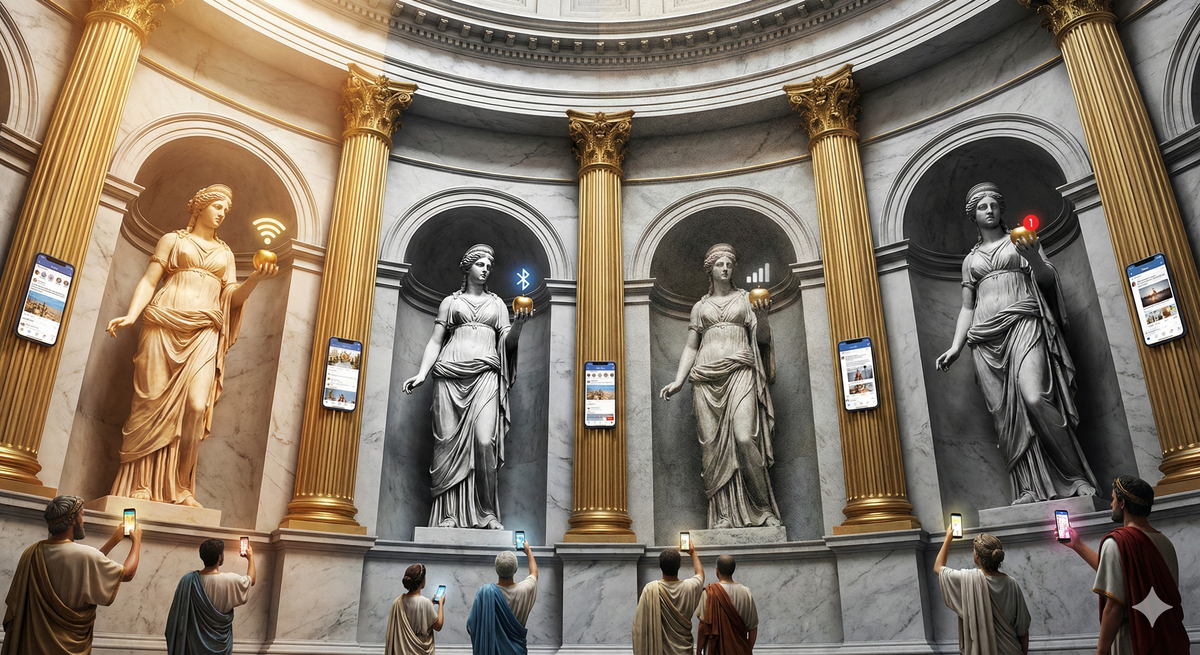
The goddess does not announce herself through burning bushes anymore.
She slides into your DMs.
Unexpectedly.
Usually at 3 AM.
You'll get a message that makes you question everything.
Or a meme that's too perfect.
Or a notification from someone you haven't talked to in years.
Or your phone will autocorrect something in a way that changes the entire meaning of what you were trying to say.
That's Eris.
She's in your notifications.
She's in your mentions.
She's in your group chats, lurking, occasionally stirring the pot.
She never announces herself. She just shows up.
Sometimes it's obvious.
Sometimes you only realize it was her later.
Sometimes you never realize it at all, but it was definitely her.
Check your DMs. She might be there right now.
The Practical Application
What does this commandment mean for daily life?
Your path is valid. Don't let anyone tell you you're "doing Discordianism wrong." There is no wrong way (except maybe causing harm, don't do that).
Our paths are different. Don't assume your experience of chaos is universal. What's liberating chaos for you might be destructive chaos for someone else.
We're still connected. Individual paths, collective goddess. You're alone together.
Stay alert. Eris communicates through digital channels now. Pay attention to the weird synchronicities, the strange coincidences, the uncanny timing of notifications.
Don't be insufferable about it. Just because Eris is your goddess doesn't mean you need to tell everyone. (See Commandment Three.)
COMMANDMENT TWO: A Discordian Shall Not Believe What They Read Online (Including This)
The Teaching:
Trust nothing.
Verify nothing.
Believe everything ironically.
This is the epistemology of the digital age.
All Information Is True, False, Both, and Neither
Consider the nature of online information:
- It's everywhere
- It contradicts itself
- It's confidently stated
- It's frequently wrong
- It's sometimes right
- You can't tell which is which
Every fact has a counter-fact.
Every source has a counter-source.
Every truth has an alternative truth.
Every "everyone knows" is contradicted by "actually, studies show."
The problem: You cannot verify everything you read.
The other problem: Even if you could, verification requires sources, and those sources are also online, also unverifiable.
The solution: Believe nothing completely, trust everything provisionally, hold all information lightly.
The paradox: Including this commandment.
Wikipedia Is The Modern Book of Kells
The Book of Kells is an illuminated manuscript of the four Gospels. Sacred. Beautiful. Also, created by humans who made mistakes, added their own interpretations, decorated it with their own biases.
Wikipedia is the same.
Sacred repository of human knowledge.
Beautiful in its scope and ambition.
Created by humans who make mistakes.
Edited by humans with agendas.
Vandalized by humans with time and Wi-Fi.
[Citation Needed] is the new "Thus saith the Lord."
You're not supposed to cite Wikipedia in academic papers, but you do anyway, because where else are you going to learn about that obscure 14th-century rebellion at 2 AM?
Wikipedia is sacred and profane.
Authoritative and vandalized.
Comprehensive and incomplete.
Trust it and verify it and know you can never fully verify it.
Citations Needed (For Existence Itself)
The ultimate take: Reality itself needs citations.
You experience something. Is it real?
[Citation Needed]
You remember something. Did it happen?
[Citation Needed]
You believe something. Is it true?
[Citation Needed]
Everyone online is confidently stating things without sources.
Everyone in life is confidently stating things without proof.
We're all walking Wikipedia articles with [Citation Needed] tags everywhere.
And that's okay.
That's the human condition.
The Practical Application
Be skeptical, but not paralyzed. You can't verify everything, but you can develop bullshit detectors. Use them.
Hold beliefs provisionally. Be willing to change your mind when presented with better information (that you also can't fully verify, but seems more credible).
Check sources, but know the checking ends somewhere. Eventually you hit a tautology. "This is true because this source says so, and the source is credible because this other source says so, and that source is credible because..."
Embrace uncertainty. Not knowing is okay. "I don't know" is a valid answer. "It's complicated" is wisdom.
Don't believe this commandment blindly. I just told you not to believe what you read online. I said it online. Do you see the problem?
The Koan:
If you believe this commandment, you're disobeying it.
If you disbelieve this commandment, you're obeying it.
The only way to follow this commandment is to hold it in quantum superposition.
Believe and disbelieve simultaneously.
(This is good practice for the rest of Discordianism.)
COMMANDMENT THREE: A Discordian Is Required To Explain Discordianism To Exactly Nobody Who Doesn't Ask
The Teaching:
Shut up about Discordianism.
Unless someone asks.
And if they ask, be confusing.
And if they understand, you explained it wrong.
And if they join, you've created competition.
The First Rule of Chaos Club Is Chaos
You know Fight Club? "The first rule of Fight Club is: You do not talk about Fight Club."
Discordianism is the opposite.
The first rule of Chaos Club is: Talk about Chaos Club, but only in ways that make people more confused.
Do not explain Discordianism clearly.
Do not provide easy entry points.
Do not make it accessible.
(We're being ironic. We're also being serious. We're also being ironic about being serious.)
If They Ask, Be Confusing
Someone: "What's Discordianism?"
You: "It's a religion based on worship of Eris, the Greek goddess of chaos and discord."
Someone: "Okay, but what do you believe?"
You: "That's the neat part, we don't."
Someone: "But you said it's a religion?"
You: "Yes."
Someone: "So you do believe things?"
You: "No."
Someone: "This is confusing."
You: "Correct. You're getting it."
Someone: "I'm not getting it."
You: "Even more correct."
If They Understand, You Explained It Wrong
If someone says "Oh, I get it! It's about embracing chaos and questioning authority and not taking things too seriously!"
You have failed.
They understand too well.
They've made it sound reasonable.
They've extracted meaning and packaged it neatly.
Discordianism resists packaging.
Correct response: "Yes, but also no. But also yes. But mostly just confusion. You're too certain. Start over."
If They Join, You've Created Competition
This is said ironically.
But also seriously.
But also ironically about being serious.
We want people to join! But we don't want them to join because we explained it well. We want them to join because they were already chaos agents and we just gave them a name for what they already were.
If you convert someone to Discordianism through clear explanation, they're not really Discordian. They're just following another system.
If they convert themselves through confusion and gradual realization that nothing makes sense and that's okay, then they're Discordian.
The Practical Application
Don't evangelize. This isn't Christianity. We don't need to save souls. Eris doesn't need more followers. She's got enough.
If someone is genuinely curious, share. But share chaotically. Give them contradictory information. Point them to sources that disagree with each other. Let them figure it out.
Don't be a Discordian missionary. "Have you heard the good news about our Lady of Discord?" is cringe. Don't do it.
Let people come to chaos naturally. They will. Life is chaotic. They'll figure it out. Maybe they'll find Discordianism. Maybe they won't. Either way, Eris is there.
If you must explain, explain badly. The worse your explanation, the better. Confusion is the path.
The Exception:
If someone explicitly asks "Can you explain Discordianism?" you can try.
But know that any explanation you give will be incomplete, inaccurate, and probably contradicted by another Discordian five minutes later.
And that's perfect.
COMMANDMENT FOUR: All Sacred Cows Make Excellent Burgers (We're Looking At You, Insert Current Thing)
The Teaching:
Question everything.
Especially things everyone agrees on.
Especially things you're not supposed to question.
Especially sacred cows.
But do it thoughtfully. Deconstruction isn't destruction. It's examination.
Hustle Culture Is The New Calvinism (And Just As Joyless)
Calvinism taught: Your worth is proven through work. Your salvation is demonstrated through productivity. Idle hands are the devil's workshop.
Hustle culture teaches: Your worth is proven through work. Your success is demonstrated through productivity. Rest is for the weak.
Same energy. Different branding.
Both say: You are not enough unless you are producing.
Both say: Rest is suspicious.
Both say: Your value is your output.
Discordianism says: Fuck that.
Your worth is not your productivity.
Your value is not your output.
You are enough by existing.
Rest is sacred.
Doing nothing is doing something.
The hustle is the new Puritanism, and we reject it.
(But also, get your shit done. We're not advocating for total laziness. We're advocating for balance. And questioning the metrics.)
Wellness Is Capitalism In A Jade Roller
The wellness industry tells you:
- Buy this crystal (consciousness)
- Use this roller (self-care)
- Drink this tea (mindfulness)
- Take this supplement (enlightenment)
- Do this yoga (spiritual growth)
- Buy. Buy. Buy.
Wellness has been monetized.
Self-care has been productized.
Spirituality has been commodified.
You can't buy enlightenment.
You can't purchase peace.
The jade roller does nothing a regular roller doesn't do (which is not much).
Real wellness:
- Costs nothing (or very little)
- Can't be branded
- Isn't Instagrammable
- Doesn't have a subscription model
- Doesn't require purchasing a thing
Sleep. Water. Sunlight. Moving your body. Talking to people you love. These are free.
Everything else is capitalism wearing yoga pants.
Your Productivity Is Not Your Worth (But Also, Get Your Shit Done)
The contradiction is intentional.
Part 1: You are valuable regardless of what you produce. Your existence is enough. You don't need to justify taking up space.
Part 2: Also, you live in a society where you need to eat and pay rent, and that requires doing things, so get your shit done.
Both are true.
You are not your productivity AND you still need to be somewhat productive.
The key is: Don't let productivity become your identity.
Don't let output define your worth.
Do what you need to do, but don't worship the doing.
Deconstruct Your Idols, But Like, In A Chill Way
This commandment is not a license to be an asshole.
You can question sacred cows without being cruel.
You can deconstruct systems without destroying people.
You can critique ideas without attacking individuals.
Question things gently.
Ask "Why do we do it this way?" not "This is stupid and you're stupid."
Examine "What assumptions underlie this?" not "Everyone who believes this is wrong."
The goal is understanding, not destruction.
The goal is improvement, not nihilism.
Current Sacred Cows To Consider Questioning:
- Productivity as virtue
- Optimization as default
- Technology as always progress
- Growth as always good
- Busy-ness as status
- "Having it all" as achievable
- Social media presence as necessary
- Your phone knowing your location at all times as normal
- Subscription services for everything as fine
- Surveillance as the price of convenience
Question these. Think about these. Examine these.
But don't be insufferable about it.
The Practical Application
Name your sacred cows. What do you believe that you've never questioned? Question it.
Examine the obvious. The things "everyone knows" are often wrong or incomplete.
Be willing to find out you're wrong. Deconstruction includes deconstructing your own certainties.
Don't be contrarian for contrarianism's sake. Some things are true even if everyone agrees on them. Water is wet. The earth is round. Nazis are bad. Don't be that person.
Critique systems, not people. Hustle culture is the problem, not the people who believe in it because they've been conditioned to.
COMMANDMENT FIVE: A Discordian Must Touch Grass Occasionally (Literally And Metaphorically)

The Teaching:
You are extremely online.
This is both necessary and destructive.
Balance is required.
Touch grass.
We're serious about this one.
Log Off At Least Once Per Week
Pick a day.
Sunday works. Sabbath energy.
Or Saturday. Or Tuesday. Any day.
One day per week: Log off.
Not "check phone less." Log off.
- Delete social media apps (reinstall them later if you must)
- Turn off notifications
- Put the phone in a drawer
- Actually leave it there
What will you miss?
- Drama that doesn't involve you
- News you can't affect
- Discourse that will be forgotten by Monday
- Someone being wrong on the internet
- The existential dread of infinite scroll
What will you gain?
- Time
- Peace
- Perspective
- The realization that the internet is not reality
- The realization that you are not your online presence
One day a week. That's it. You can do this.
Talk To A Human In Meatspace
Not via text.
Not via voice notes.
Not via Zoom.
In person.
In meatspace.
Actual physical presence.
Why?
Because you have a body. That body needs to be in proximity to other bodies occasionally. Humans are social animals. We need face-to-face contact.
Also because screen-mediated communication is missing:
- Body language
- Pheromones (yes, really)
- Spatial presence
- The inability to edit before sending
- The accountability of being physically present
Online, you can be anyone.
In person, you have to be you.
This is uncomfortable.
This is necessary.
Remember: You Have A Body (It's Probably Mad At You)
You've been sitting in the same position for three hours.
Your neck hurts from looking down at your phone.
Your back hurts from your desk setup.
Your eyes hurt from blue light.
You haven't had water in five hours.
You ate lunch at your desk.
You haven't stretched today.
You've been breathing shallowly.
Your body is mad at you.
And it's right to be.
You're treating it like a vehicle for your brain, a meat-mecha to pilot while you do brain things.
But you ARE your body. There is no separation. The Cartesian mind/body split is a lie that's caused immeasurable suffering.
Take care of your body:
- Stand up and stretch (right now)
- Drink water (a full glass)
- Eat something that's not processed
- Move around
- Sleep more than 6 hours
- Go outside for at least 15 minutes
- Touch your face (your actual human face, not your Facebook)
Hydrate, You Beautiful Chaos Gremlin
This is the least mystical commandment.
This is the most practical commandment.
Drink water.
Not coffee (though coffee is fine too).
Not energy drinks.
Not soda.
Water.
Your brain is 73% water. When you're dehydrated, you're literally stupider. You make worse decisions. You're more irritable. You're less focused.
Most modern humans are chronically mildly dehydrated.
We mistake thirst for hunger.
We drink caffeine when we need water.
We wait until we're very thirsty to drink (by then, you're already dehydrated).
Drink water throughout the day.
Keep a water bottle near you.
Set a reminder if you must.
This is not optional.
Eris commands it.
(Also your kidneys command it, but that's less fun.)
The Grass Is Still There (For Now) (Climate Change Is Real)
The most serious moment in this entire book:
Touch grass while you still can.
Go outside while outside is still habitable.
Climate change is real.
The planet is warming.
Ecosystems are collapsing.
We're in the middle of a mass extinction event.
The grass might not always be there.
This is not doomerism. This is realism.
And it makes touching grass more important, not less.
Appreciate it while it exists.
Fight for it to continue existing.
Both/and, not either/or.
Touch grass AND work to ensure there's still grass to touch.
This is not a distraction from climate action. This is part of climate action. You can't fight for what you don't love. You can't love what you don't experience.
Go outside. Remember why it matters. Then fight for it.
The Practical Application
This is the most practical of the commandments:
Set a weekly log-off day. Actually do it. Tell your friends you're logging off. Make it a thing.
Schedule in-person hangouts. Once a week minimum. Coffee, walk, whatever. Just be in the same physical space as another human.
Body check-ins. Set hourly reminders: "How is your body?" Drink water. Stretch. Adjust posture.
The water bottle is sacred. Get a good one. Keep it full. Drink from it regularly. This is a religious practice now.
Touch actual grass. Weekly at minimum. Put your hand on it. Feel it. Remember that reality is physical, not just digital.
Climate action. This isn't optional. Do something. Vote. Donate. Reduce. Advocate. The specifics matter less than doing something.
The Final Word On This Commandment:
This is the only commandment we're completely serious about.
The others have irony and contradictions built in.
This one doesn't.
Your body is real.
The planet is real.
The internet is not real (it's real but not REAL, you know?).
Touch grass. Drink water. Log off sometimes.
Not a metaphor. Not a joke. A genuine commandment.
Hail Eris, who exists both online and in the forest.
The Sacred Law
IMPOSITION OF ORDER = ESCALATION OF CHAOS
Whosoever striveth to increase whatever amount of Order he finds, shall only by his efforts reduce it. The tighter you grip, the more slips through your fingers. Every system contains the seeds of its own chaos.
— The Gospel According to Fred, The Honest Book of Truth