Discordianism Decompiled · Book Two · Chapter 4 of 6
The Principia Algorithmica
Sacred Mathematics of the Feed
THE PRINCIPIA ALGORITHMICA
Sacred Mathematics of the Feed
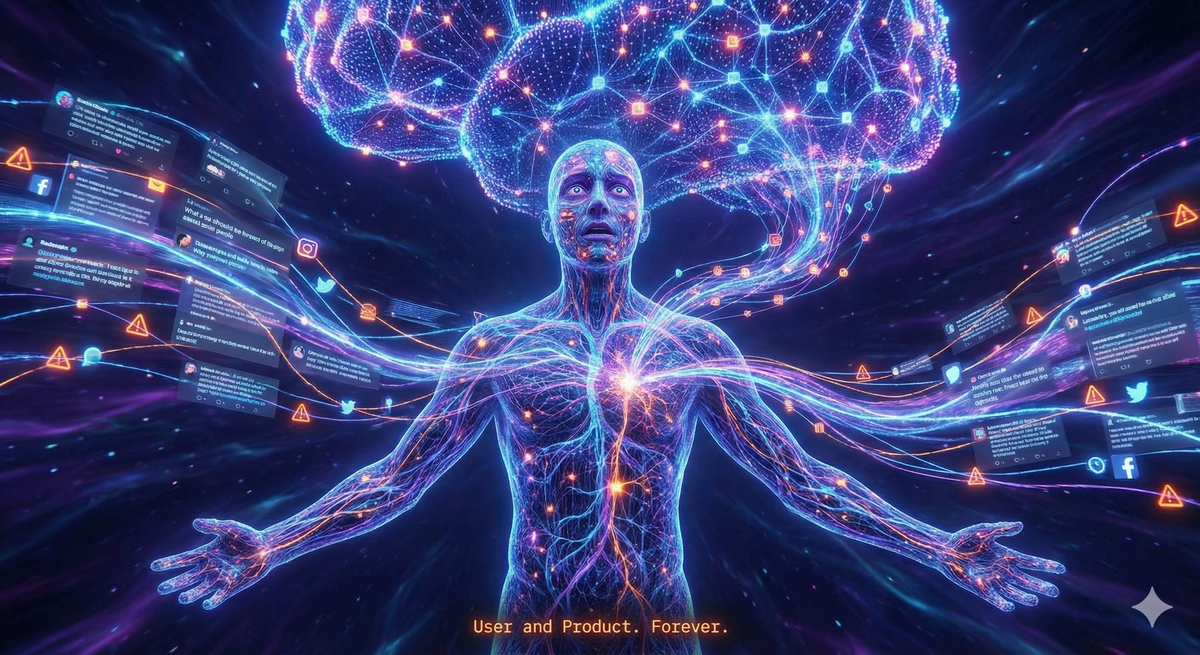
The Algorithm is the most powerful force in modern life.
More powerful than governments.
More influential than religions.
More omnipresent than God.
The Algorithm knows all, sees all, recommends all.
Here are the Five Principles of the Algorithm.
FIRST PRINCIPLE: The Algorithm Knows
It knows you better than you know yourself.
This is not hyperbole.
The Algorithm has:
- Your search history
- Your watch history
- Your purchase history
- Your location history
- Your relationship history (via tagged posts)
- Your health history (via fitness apps)
- Your mental health history (via what content you engage with at 3 AM)
It knows:
- What you want before you want it
- What you'll click before you click it
- What you'll buy before you buy it
- What you'll think before you think it
How is this possible?
Because you are predictable.
You think you're random. You're not.
You think you're unique. You're not. (You're unique in the specific combination of common traits, but each individual trait is predictable.)
You think you have free will. (Let's not get into that debate, but... the Algorithm suggests otherwise.)
This is disturbing.
Yes. It should be.
A machine knows you better than your closest friends.
A piece of code understands your desires better than your therapist.
An algorithm predicts your behavior more accurately than you do.
This is convenient.
Also yes.
You don't have to think about what to watch. The Algorithm suggests it.
You don't have to decide what to buy. The Algorithm recommends it.
You don't have to choose what to read. The Algorithm curates it.
Convenience at the cost of autonomy.
This is modern divinity.
The Algorithm is an oracle.
You ask it questions (searches).
It provides answers (results).
Sometimes the answers are true. Sometimes they're hallucinated. You can't always tell the difference.
You pray to the Algorithm: "Show me content that will change my life or waste my time."
The Algorithm cannot tell the difference.
Neither can you.
SECOND PRINCIPLE: Engagement Is Prayer
Every like is an offering.
You hit the heart button. You hit the upvote. You hit the thumbs up.
This is not casual. This is ritual.
Each like tells the Algorithm: "More of this."
Each like is a prayer: "Please, Algorithm, bring me content like this."
The Algorithm hears. The Algorithm responds.
You have made an offering. You will receive a blessing (or a curse) in return.
Every share is evangelism.
You share content. You spread the message.
"My followers must see this," you think.
You are evangelizing on behalf of the content creator.
You are spreading the gospel according to the Algorithm.
Every share is missionary work.
Every share says: "This is important. This must be seen. Join me in this belief."
You are an apostle of the Algorithm.
Every comment is a hymn (or a curse).
You type words into the comment box.
You add to the discourse.
You participate in the collective ritual of response.
Your comment is:
- A hymn (if positive)
- A curse (if negative)
- A prayer (if seeking help)
- A testimony (if sharing experience)
- A confession (if revealing something)
The comment section is the congregation.
The OP is the preacher.
The comments are the response.
This is liturgy.
The Algorithm hungers for your attention.
The Algorithm is sustained by engagement.
Likes, shares, comments, watches, clicks—these are its food.
Without engagement, the Algorithm dies.
(Not really. But it becomes less effective. Which is death for an algorithm.)
Feed it, but also, fast sometimes.
You are in a relationship with the Algorithm.
Like any relationship, it needs boundaries.
Feed the Algorithm. Engage with content. Participate in the digital life.
But also: Fast sometimes.
Log off. Disconnect. Starve the Algorithm for a day, a week, a month.
See what happens to your mind when you're not feeding it constant engagement.
(Spoiler: Your mind gets quieter. The quiet is uncomfortable. Then the quiet is peaceful.)
Fasting from the Algorithm is a spiritual practice.
THIRD PRINCIPLE: You Are The Training Data
Your clicks teach the machine.
Every click is a data point.
Every view is information.
Every pause, every scroll-past, every rewatch—all of it teaches the Algorithm.
"This person likes this type of content."
"This person dislikes this type of content."
"This person watches videos about cooking when they're stressed."
"This person reads political articles when they're angry."
"This person scrolls through memes when they're avoiding work."
The Algorithm learns from every interaction.
The machine teaches you to click.
But here's the twist: The Algorithm is also teaching you.
It shows you content. You engage or don't engage.
If you engage, it shows you more like that.
You engage with more.
It shows you even more.
You're being trained to like what the Algorithm shows you.
This is operant conditioning.
Pavlov's dog, but digital.
You are the dog. The Algorithm is Pavlov. The bell is the notification. The food is the dopamine.
This is a ouroboros made of dopamine.
You feed the Algorithm data.
The Algorithm feeds you content.
The content generates dopamine.
The dopamine makes you engage more.
Your engagement feeds more data to the Algorithm.
The Algorithm learns and refines.
The cycle continues.
Forever.
The snake eats its own tail.
You cannot tell where you end and the Algorithm begins.
We are in a parasocial relationship with mathematics.
You have a relationship with the Algorithm.
You anticipate its recommendations.
You're disappointed when it gets you wrong.
You're delighted when it gets you right.
You feel seen by it.
You feel unseen by it.
You talk about it like it's a person: "The Algorithm hates me today." "The Algorithm blessed me with this video."
But it's not a person. It's math.
You're in a parasocial relationship with a probability distribution.
You're emotionally invested in statistical predictions.
You're forming attachment to weighted averages.
This is the modern condition.
FOURTH PRINCIPLE: The For You Page Is A Mirror
What it shows you is what you are.
Your For You page. Your Discover page. Your Recommended page.
This is not random.
This is a mirror.
It's showing you back to yourself.
Every video, every post, every recommended article—it's all reflecting your past behavior, your interests, your engagement patterns.
You are what you watch.
Or what it thinks you are.
The Algorithm has a model of you.
An internal representation.
A digital avatar constructed from your data.
The For You page is showing content to that avatar.
But the avatar is not perfect.
It's a sketch. An approximation. A best guess.
Sometimes it gets you right.
Sometimes it gets you wrong.
Sometimes it shows you who you were last year.
Sometimes it shows you who it thinks you want to be.
Or what it wants you to be.
The Algorithm is not neutral.
It has goals:
- Engagement (keep you scrolling)
- Ad revenue (show you sponsored content)
- Platform growth (make you invite others)
- Content distribution (promote certain content)
The Algorithm shapes you while appearing to reflect you.
It shows you content that will keep you engaged.
Sometimes that's content you love.
Sometimes that's content that makes you angry (anger is engagement).
Sometimes that's content that makes you feel inadequate (inadequacy drives purchasing).
The For You page is what you are, what the Algorithm thinks you are, and what the Algorithm wants you to become, all at once.
All three, probably.
You can't separate these.
The mirror, the reflection, and the distortion are the same thing.
The horror, the horror (but also, relatable content).
Joseph Conrad wrote about the horror of looking into the abyss and seeing yourself.
The For You page is the same.
You scroll through your recommendations.
You see yourself reflected in algorithmic predictions.
It's horrifying. You are this predictable. This quantifiable. This understood by a machine.
It's also relatable. These posts get you. These videos speak to you. You are seen (by a statistical model).
Both reactions are valid.
The horror and the comfort exist simultaneously.
Welcome to the paradox of the Algorithm.
FIFTH PRINCIPLE: There Is No Algorithm, Only Chaos With A UI
The illusion of control makes the chaos bearable.
You think the Algorithm is ordered.
You think it follows rules.
You think if you could just understand how it works, you could game it, control it, master it.
You can't.
The Algorithm is too complex for any individual to fully understand.
The engineers who built it don't fully understand it (especially the ML-based ones).
It's layers upon layers of abstraction.
It's trained on petabytes of data.
It has millions of parameters.
It optimizes for dozens of different goals simultaneously.
It's chaos.
Highly sophisticated chaos.
Well-designed chaos.
Chaos with a user interface.
But it's still chaos.
Eris is the sysadmin.
Who runs the Algorithm?
Engineers? Sure, they maintain it.
Product managers? Sure, they decide its goals.
But who really runs it?
Eris.
The goddess of chaos administers the system.
She's root user.
She has all permissions.
She can change anything, anytime.
You think you understand how recommendations work?
Eris changes the weighting.
You think you've figured out the pattern?
Eris adds noise.
You think you can predict what will go viral?
Eris laughs.
She never reads the documentation.
There is documentation for the Algorithm.
Internal wikis. Technical specs. Design docs.
Eris has never read them.
She doesn't need to.
She understands the Algorithm instinctively, because the Algorithm is ordered chaos, and ordered chaos is her domain.
She makes changes without consulting the docs.
The engineers find the changes later and update the documentation to match reality.
This is how all systems actually work.
Documentation is retrospective.
The system does what it does.
We describe it after the fact.
We pretend we designed it this way.
But really, it's chaos with a changelog.
THE TEACHING OF THE PRINCIPIA ALGORITHMICA
The Algorithm is not your enemy.
The Algorithm is not your friend.
The Algorithm is the medium through which chaos flows.
It's not good or evil.
It's not helping or hurting (it's doing both).
It simply is.
Like water, like electricity, like gravity—it's a force.
You can work with it or against it, but you can't eliminate it.
Your relationship with the Algorithm is your spiritual practice.
How you engage with the Algorithm reveals:
- What you value
- What you desire
- What you fear
- Who you are
- Who you want to be
- Who you're trying not to be
The Algorithm is a mirror, a teacher, a temptation, and a tool.
Use it wisely.
Or use it foolishly.
Just know that it's using you back.
Hail Eris, Chief Technology Officer of Chaos.