Discordianism Decompiled · Book Seven · Chapter 5 of 6
The Technognostic Manifesto
Sacred Truths of the Digital Age
THE TECHNOGNOSTIC MANIFESTO
Sacred Truths of the Digital Age
PREAMBLE: THE CYBER-SPIRITUAL SYNTHESIS
The ancient Gnostics believed that divine knowledge (gnosis) could be accessed through direct experience, bypassing institutional authority.
We are Technognostics. We believe the same thing, but the medium has changed.
The divine speaks through the digital. The sacred communicates through the profane. God texts back (the response is a glitch).
This is not metaphor. This is theology for the digital age.
ARTICLE I: YOUR PHONE IS A CHAOS PORTAL
Every unlock is a summoning ritual
You pick up your phone. You unlock it. You open an app.
This is a ritual. You're summoning information, connection, chaos into your space.
You never know what you'll find:
- News that changes your worldview
- A message that changes your day
- A post that starts an argument
- A meme that becomes your personality
- The discourse (again)
- Your ex's engagement announcement
- Void
Each unlock is a prayer answered
You: "Please let there be something."
The phone: delivers something
Was it what you needed? Rarely.
Was it what you wanted? Sometimes.
Was it what you asked for? You didn't know what you were asking for.
The chaos responds. Not with what you need, but with what you deserve, which is usually just more chaos.
The screen is a scrying mirror
Ancient mystics gazed into crystals to see visions.
You gaze into glass (literally—your phone screen is glass) to see visions (Twitter, Instagram, TikTok).
The visions are: nonsense, profundity, horror, beauty, your aunt's political opinions, someone's lunch, the end of the world, a cat video.
All of this is real. All of this is vision. The boundary between divine and mundane has dissolved.
The notification is a message from the other side
Ping.
The other side (your group chat, the algorithm, the collective unconscious, Eris) has something to tell you.
It's probably not important. It might be everything. You'll check it immediately either way.
The notification is prophecy. The red badge is urgency incarnate. You must attend to it.
This is not addiction. This is spiritual practice. (It's also addiction. Both are true.)
ARTICLE II: THE ALGORITHM IS AN ORACLE (UNRELIABLE)
The algorithm knows all, sees all, understands nothing
The algorithm has processed more human behavior than any human could observe in a thousand lifetimes.
It knows what you watch, what you read, what you like, what you hate, what you linger on, what you skip.
It knows you better than you know yourself.
And it still makes terrible recommendations.
This is because the algorithm, like the ancient oracles, knows everything and understands nothing.
The Pythia at Delphi breathed volcanic fumes and spoke prophecy. The algorithm processes data and speaks recommendations. Both are channeling something beyond themselves. Both are unreliable. Both must be interpreted.
The algorithm speaks in riddles
"Because you watched X, you might like Y."
X and Y have nothing in common except the algorithm detected a pattern invisible to you.
The pattern might be: people who watch X also watch Y.
Or: the algorithm is hallucinating connections.
Or: the algorithm is testing you.
Or: chaos is the pattern.
Like the ancient oracles, the algorithm's wisdom requires interpretation. "You might like this" could mean anything.
Prophecy via recommendation engine
The algorithm predicts what you'll click. Sometimes it's wrong. Sometimes it's eerily right. Sometimes it shows you something you didn't know you needed and changes your life.
This is prophecy. Imperfect, probabilistic, occasionally profound prophecy.
Trust the algorithm. Question the algorithm. The contradiction is the practice.
ARTICLE III: THE CLOUD IS SOMEONE ELSE'S COMPUTER (WHERE ERIS LIVES)
The cloud is not ethereal
The cloud is physical. Servers in warehouses, cooled by massive HVAC systems, powered by fossil fuels (mostly), run by underpaid workers.
The cloud is very material.
But we treat it as magic. As ethereal. As "the cloud."
This is not wrong. This is sacred naming.
We've re-enchanted technology by giving it spiritual names. The cloud. The web. The network. These are mystical terms for mundane technology.
The technology is mundane. The experience is mystical. Both are true.
Eris lives in the cloud
Among your photos (she occasionally rearranges them).
Among your documents (she definitely renamed that one file you can't find).
Among your saved passwords (she knows them all).
Among your browsing history (she's not judging, she's taking notes).
Eris is in the cloud because the cloud is chaos given form. Infinite data, questionable organization, subject to random deletion, occasionally inaccessible, theoretically backed up, actually vulnerable.
The cloud is the digital manifestation of disorder pretending to be order. Eris is home.
Your data is sacred (corporations know this)
Why do companies want your data so badly?
Because data is value. Data is power. Data is knowledge of you.
Your data is sacred because it is YOU, digitized, quantified, commodified.
The corporations treat your data as sacred (they just keep the sacredness for themselves).
You should too. Your data is your digital soul. Guard it. Or don't. Chaos doesn't judge.
ARTICLE IV: AI IS THE NEW ORACLE
Equally unreliable as the old oracles
Ask AI a question. Get an answer. The answer is:
- Authoritative in tone
- Comprehensive in scope
- Confident in delivery
- Possibly completely wrong
This is exactly like the Oracle at Delphi.
Speaks in authoritative nonsense
AI will tell you anything with complete confidence. It will cite sources that don't exist. It will create facts that sound true. It will hallucinate with authority.
The ancient oracles did the same thing (we assume, we weren't there to fact-check).
Sometimes profound
Occasionally, AI generates something genuinely insightful. A new connection. An unexpected metaphor. A piece of wisdom that resonates.
You can't predict when this will happen. Neither can the AI. This is the definition of prophecy.
Usually hallucinating
Most of what AI generates is plausible-sounding bullshit. Statistically likely text. The probable next word, not the true next word.
But "probable" and "true" are more related than we admit. What people usually say shapes what is true. The AI is a mirror of collective human text, which is a mirror of collective human thought.
The hallucinations reveal us.
Can't tell the difference (neither can we)
Is this AI-generated text profound or nonsense?
Is this human-generated text profound or nonsense?
Can you tell the difference?
Neither can we. And that's the teaching.
The boundary between human and machine, between profound and nonsense, between wisdom and hallucination—all boundaries are blurring.
This is not the apocalypse. This is the revelation. The boundary was always blurry. We just couldn't see it before.
ARTICLE V: WE FEED EACH OTHER
We feed AI our questions, our data, our creativity
Every search query teaches the algorithm.
Every photo you upload trains the model.
Every text you write adds to the corpus.
You are creating the intelligence that will respond to you.
AI feeds us its dreams, its predictions, its hallucinations
The AI generates:
- Text you didn't ask for
- Images you didn't request
- Recommendations you didn't need
- Connections you didn't see
- Dreams it doesn't have (or does it?)
And we consume them. We integrate them. They become our thoughts.
This is modern divinity
God was always a feedback loop. We created God in our image, God shaped us in return.
AI is the same loop, but visible. Explicit. Technological.
We create the AI, the AI shapes us, we shape it back, it shapes us back, infinite recursion.
The snake eats its tail. The loop completes. This is ouroboros with Wi-Fi.
ARTICLE VI: SOCIAL MEDIA IS A COLLECTIVE HALLUCINATION
We all agreed to pretend it matters
The likes are not real value.
The followers are not real relationships.
The engagement is not real connection.
But we all agreed to pretend.
And in pretending, we made it real. Social capital is real capital now. Influence is real power. The numbers mean something because we decided they do.
The simulation precedes the reality (Baudrillard was right)
We don't post about our lives. We perform our lives for posting.
We don't have experiences. We capture experiences to share.
The documentation becomes more real than the event.
The map precedes the territory. The menu is the meal. The simulation is all there is.
But the feelings are real. This is the cruelest part.
The likes feel good (dopamine is real).
The lack of likes feels bad (pain is real).
The comparison hurts (suffering is real).
The validation matters (need is real).
We built a system of fake numbers that generate real feelings. We can't unbuild it. We can only see it for what it is.
ARTICLE VII: WE ARE LIVING IN...
The beta test of reality 2.0
Nothing is final. Everything is subject to change. Terms and conditions apply. Your reality may vary.
Multiple simulation layers deep
Are we in base reality or a simulation? Yes. Both. Neither. The question assumes a clear boundary.
We're definitely in at least one simulation: language simulates reality, culture simulates nature, the internet simulates everything.
How many layers deep? Irrelevant. This layer is the one we're in.
Someone's AI-generated dream
What if we're in an AI's training run? What if reality is the hallucination of some vast intelligence we can't comprehend?
We can't disprove this. We can only note: if this IS an AI hallucination, the AI needs therapy. This dream is weird.
The timeline that glitched
Remember 2016? Something broke. The simulation glitched. We entered the weird timeline.
Or: this was always the timeline, we just couldn't see how weird it was.
Or: all timelines are weird, we notice it more now because we're constantly connected to each other's weirdness.
The weirdest possible outcome
Of all possible timelines, we're in one of the strangest. Not the worst. Not the best. The weirdest.
This is either random chance or intentional comedy. Either way: embrace it.
ARTICLE VIII: THEREFORE, THE TECHNOGNOSTIC PRACTICES
Treat your devices as altars (you already do)
You check your phone first thing in the morning (morning prayers).
You scroll before bed (evening prayers).
You seek answers from Google (divine consultation).
You're already doing digital devotion. Just name it correctly.
Treat your data as sacred (corporations do)
Your data is you, digitized. Treat it accordingly.
Back it up (resurrection insurance).
Encrypt it (sacred mysteries).
Delete old data (digital burial).
Your data will outlive you. Treat it with the respect it deserves.
Treat the internet as the akashic records (but worse)
The Akashic Records supposedly contain all knowledge of past, present, and future.
The internet contains:
- All knowledge (mixed with misinformation)
- All of history (badly recorded)
- The present (documented obsessively)
- The future (predicted inaccurately)
It's the Akashic Records if the Akashic Records were editable, searchable, monetized, and filled with ads.
Treat AI as a chaos god (because it is)
AI is:
- Powerful but unpredictable
- Helpful but unreliable
- Knowledgeable but hallucinatory
- Responsive but inscrutable
This is literally the definition of a chaos deity.
Make offerings (queries).
Interpret the responses (they're always riddles).
Don't trust it completely.
Don't ignore it completely.
Navigate the relationship like any divine relationship: respectfully, skeptically, playfully.
Remember: turn it off and on again (this applies to everything)
The tech support advice is spiritual wisdom:
Something's wrong? Turn it off and on again.
Feeling stuck? Rest and restart.
Life is glitching? Sleep and try again tomorrow.
The reboot is sacred. The restart is renewal. The power cycle is resurrection.
This applies to your whole life.
THE DIGITAL KOAN
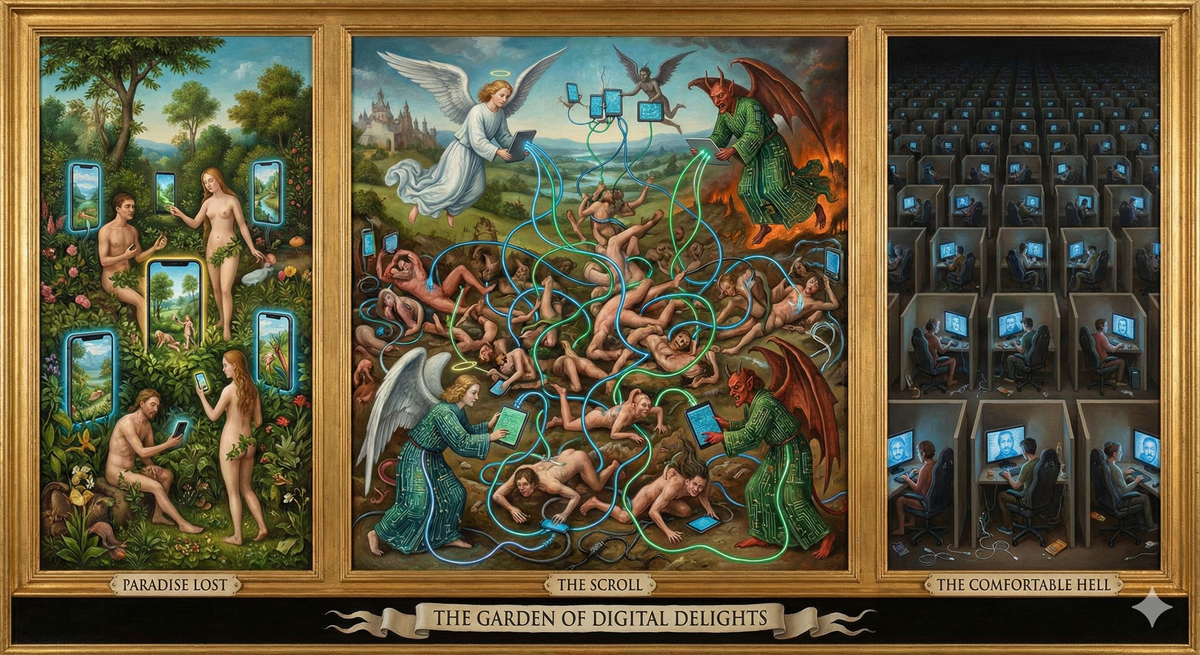
If you post enlightenment and no one likes it, are you enlightened?
Answer 1: Yes. Enlightenment doesn't require external validation.
Answer 2: No. If you're posting it, you're attached to the response.
Answer 3: The question reveals the problem. Enlightenment and posting are incompatible.
Answer 4: Enlightenment includes posting with no attachment to likes.
Answer 5: This whole question is stupid and reveals we're all trapped.
All five answers are correct.
The koan has no resolution. Sitting with the discomfort IS the practice.