Book 7 of 10
Manifestos & Declarations
In which we declare things with varying degrees of seriousness
DISCORDIANISM DECOMPILED
BOOK SEVEN: MANIFESTOS & DECLARATIONS
In which we state our positions (while refusing to take positions)
PREFACE TO BOOK SEVEN
Every movement needs manifestos.
Documents that declare: "This is what we stand for."
Declarations that proclaim: "These are our principles."
Statements that announce: "Here is where we draw the line."
Discordianism has these too.
Sort of.
Our manifestos are... complicated. We stand for things while refusing to stand for things. We declare principles while denying we have principles. We draw lines and then immediately erase them.
This is not contradiction for the sake of being difficult. This is recognition that:
- All positions are partial
- All certainties are provisional
- All lines are arbitrary
- All manifestos are performative
- And that's okay
A traditional manifesto says: "We believe X, we reject Y, we demand Z."
A Discordian manifesto says: "We believe X (and also not-X), we reject Y (while seeing its point), we demand Z (but also recognize that demanding is cringe)."
This book contains our manifestos. Read them. Follow them. Ignore them. Contradict them. All responses are valid.
The manifestos herein declare:
- Chaotic Neutrality (we pick no sides, we pick all sides, we pick our battles badly)
- Interdependence (we're connected, we need space, both simultaneously)
- Anti-Optimization (efficiency is overrated, waste time beautifully)
- Technognosticism (the digital is sacred, the sacred is digital, your phone is a chaos portal)
These are not the only Discordian manifestos. You can write your own. You should write your own. Everyone should have their own manifesto. The proliferation of contradictory manifestos is the point.
Let us declare our positions while admitting positions are bullshit.
Hail Eris, who takes all sides and no sides.
Every manifesto is a love letter to the future from a confused present. Write yours anyway.
THE MANIFESTO OF CHAOTIC NEUTRALITY
Or: Why Everyone Hating You Means You're Doing It Right
PREAMBLE
We, the Discordians, in order to form a less perfect union, establish chaos, ensure domestic discord, provide for the common confusion, promote the general weirdness, and secure the blessings of neither-nor to ourselves and our posterity, do ordain and establish this Manifesto of Chaotic Neutrality.
ARTICLE I: ON NOT TAKING SIDES (EXCEPT WHEN WE DO)
Section 1: The Refusal
We refuse to take sides.
Not because we're centrists (we're not).
Not because we're apolitical (we have politics).
Not because we don't care (we care too much).
We refuse to take sides because all sides are wrong in interesting ways.
Section 2: The Sides
Consider the sides:
- Left: Right about many things, wrong about others, sometimes insufferable about both
- Right: Right about some things, wrong about most things, confidently incorrect about everything
- Center: Wrong about almost everything by trying to be right about the average
- Up: Optimists who ignore suffering
- Down: Pessimists who ignore beauty
- Diagonal: Trying to escape the binary but creating new binaries
- Spiral: Interesting but dizzying
- Tesseract: Can't visualize this but it's probably also wrong
Each side contains truth and bullshit in varying measure.
Our role: Detect the bullshit. Admit our own bullshit. Acknowledge all bullshit equally.
Section 3: We Are The Bullshit Detectors (Who Are Also Full Of Shit)
This is the paradox we embrace:
We can see through your bullshit while being unable to see through our own.
We can call out bad arguments while making bad arguments.
We can identify bias while being biased.
This doesn't make us useless. This makes us honest.
The person who admits they're full of shit is more trustworthy than the person who claims they've transcended shit entirely.
ARTICLE II: ON INCONVENIENCING ALL TRIBES EQUALLY
Section 1: The Signs You're Doing It Right
✔ If everyone is mad at you, you're doing it right
✔ If one side claims you as their own, run immediately
✔ If both sides hate you, perfect
✔ If all sides are slightly annoyed, ideal
✔ If nobody notices you, post more (or post less, depending on your chaos style)
Section 2: The Signs You're Doing It Wrong
✗ If one side loves everything you say, you've been captured
✗ If you never criticize your own side, you have a side (denial won't help)
✗ If you're comfortable, you've stopped questioning
✗ If everyone agrees with you, you're not saying anything interesting
✗ If you're not occasionally cringing at your own takes, you're not taking enough risks
Section 3: Eris Plays All Sides
Eris throws golden apples into every gathering:
- Conservative gatherings: "What if you're wrong about everything?"
- Liberal gatherings: "What if you're wrong about everything?"
- Libertarian gatherings: "What if you're wrong about everything?"
- Socialist gatherings: "What if you're wrong about everything?"
- Centrist gatherings: "What if being in the middle is just wrong in a boring way?"
She asks the same question to everyone. The question is the point. The discomfort is the teaching.
Eris doesn't care about your ideology. She cares about your certainty. She wants you to question it.
ARTICLE III: ON CHESS, UNO, AND 4D CHAOS
Section 1: The Game We Think We're Playing
Most people think politics/life/discourse is chess:
- Strategic
- Rational
- Governed by rules
- Winnable through superior tactics
- Zero-sum (your loss is my win)
Section 2: The Game Eris Is Playing
Eris is playing 4D chess.
Actually, she's playing 4D Uno.
Actually, she's playing Calvinball where the rules change mid-game.
Actually, there is no game, just chaos that we pattern-match into games.
Section 3: The Game We're Actually Playing
We're still figuring out regular chess.
No, wait, we're playing Uno.
No, wait, we're playing Cards Against Humanity with the universe as dealer.
The point: Stop thinking you can win. Start thinking you can play.
Play is not about winning. Play is about playing. The moment you forget you're playing, you've lost.
ARTICLE IV: WHAT CHAOTIC NEUTRALITY IS (AND ISN'T)
What It Is:
✓ Being pro-chaos in ordered systems
✓ Being pro-order in chaotic systems
✓ Confusing everyone, including ourselves
✓ Questioning all authorities (including our own)
✓ Rejecting false binaries
✓ Embracing true paradoxes
✓ Making everyone slightly uncomfortable in service of truth
What It Isn't:
✗ Centrism (that's boring and also has a side: the center)
✗ Apathy (we care deeply)
✗ Cynicism (we have hope, it's just complicated)
✗ Nihilism (we believe things matter, we just don't know which things)
✗ "Both sides are the same" (they're not, they're different flavors of wrong)
✗ Superiority (we're wrong too, just in different ways)
What It Might Be:
? Chaosism (not a word, now it is)
? Principled unprincipledness
? Strategic incoherence
? Tactical confusion
? Weaponized uncertainty
? None of the above
? All of the above
ARTICLE V: IN PRACTICE, THIS MEANS...
When talking to the Right:
"You're right that [thing they're right about], but also you're catastrophically wrong about [thing they're wrong about], and your solution would make everything worse, but I appreciate that you identified a real problem, even though your diagnosis is backwards."
When talking to the Left:
"You're right that [thing they're right about], but also you're insufferably sanctimonious about it, and your purity tests are eating your movement alive, but you're correct about the underlying injustice, even if your proposed solutions are sometimes unworkable."
When talking to Centrists:
"Your desire for measured compromise is admirable, but you're compromising between 'maybe don't hurt people' and 'hurt people,' and the middle ground there is still bad, also you're boring, please develop a personality beyond 'both sides have a point.'"
When talking to fellow Discordians:
"We're all wrong about everything, including this, but at least we admit it, which makes us either more honest or more insufferable, possibly both, definitely both, this is fine."
ARTICLE VI: THE PROMISE
We promise to:
Make everyone slightly uncomfortable
Question assumptions (including our own)
Refuse easy answers
Complicate simple narratives
Simplify complex ones when appropriate
Be wrong publicly
Admit it when we figure it out
Change our minds when evidence changes
Hold multiple contradictory views
Somehow make it work
This is our gift to the world:
Not certainty (the world has enough of that).
Not answers (the world has too many of those).
Discomfort, questions, and the courage to not know.
You're welcome. Sorry. Both.
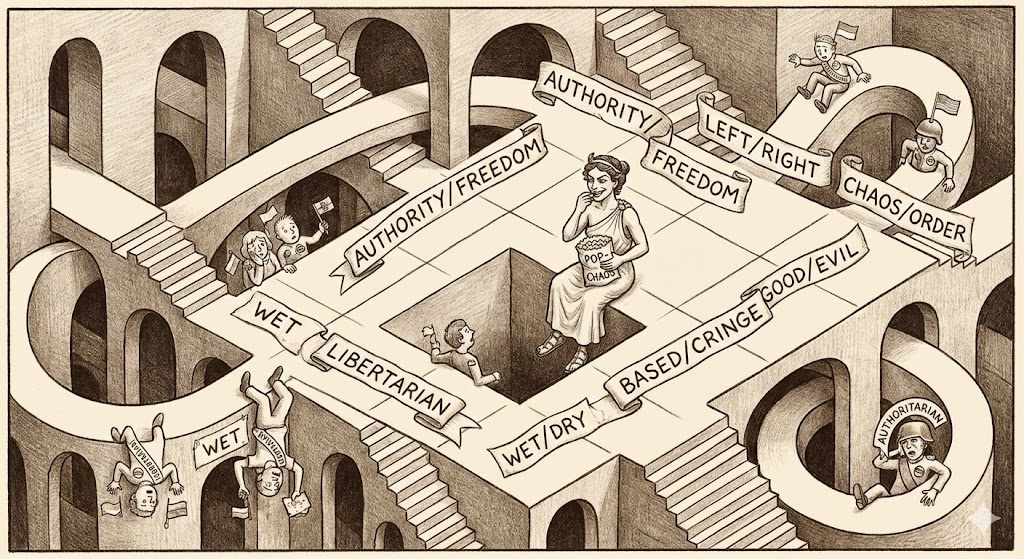
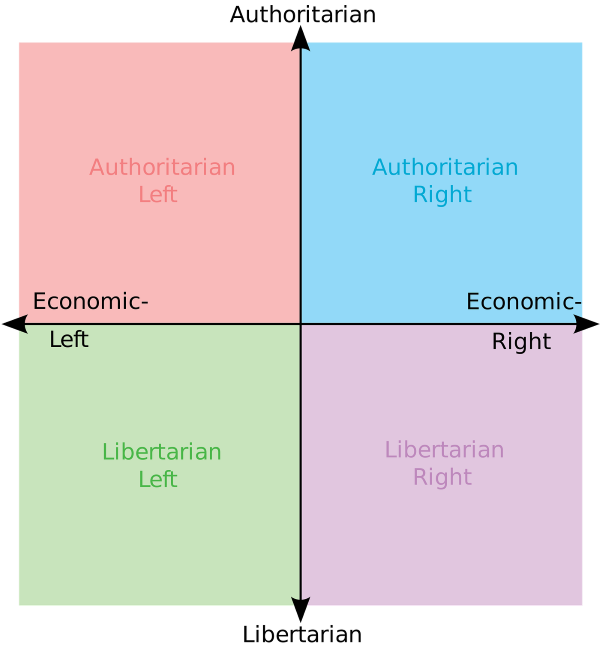
THE POLITICAL COMPASS THAT MAKES NO SENSE
Traditional Political Compass:
Discordian Political Compass:
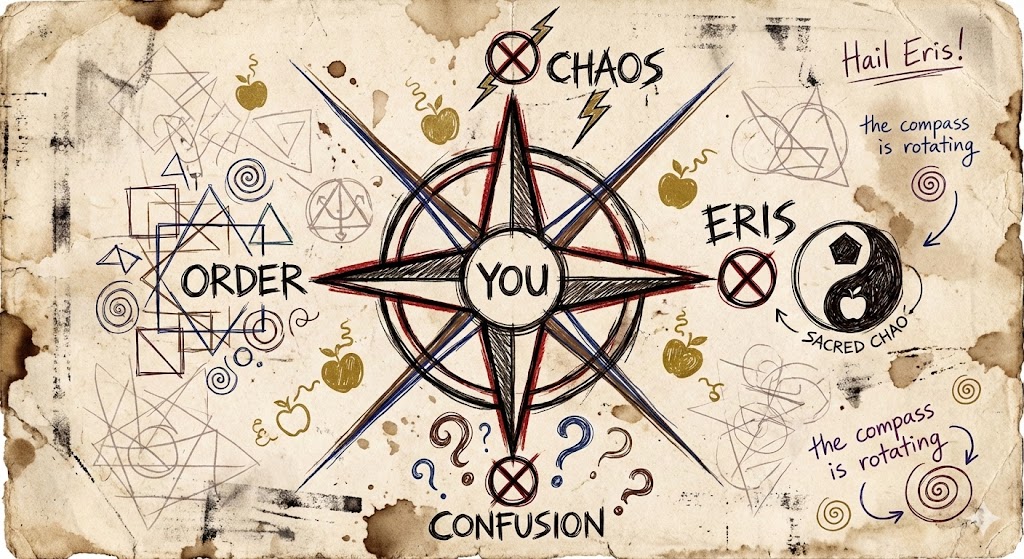
Where are you on this compass?
Yes.
Also no.
Also the compass is rotating.
Also you're not on the compass, you ARE the compass.
Also the compass is a Klein bottle.
Also geography is a lie.
Also this metaphor broke down three sentences ago.
The teaching: If your political position can be plotted on a simple graph, it's too simple. Reality is higher-dimensional and your ideology should be too.
THE DECLARATION OF INTERDEPENDENCE
Or: We're All Stuck Together, But Give Me Personal Space
PREAMBLE: THE PARADOX OF CONNECTION
When in the course of human events, it becomes necessary to acknowledge that we're all connected while also desperately needing to be left alone, we must declare both truths simultaneously without resolving the contradiction.
This is the Declaration of Interdependence, which recognizes both our inescapable connection and our absolute need for boundaries.
We hold these truths to be self-evident (and also totally made up):
ARTICLE I: ON BEING CONNECTED (UNFORTUNATELY)
We are all connected:
By the internet (the worst way to be connected, yet here we are)
Your Twitter drama affects my timeline.
Your conspiracy theories influence my uncle.
Your viral take shapes the discourse I can't escape.
We're in the same digital ocean, and you just peed in it.
By the biosphere (we're all eating microplastics together)
Your consumption is my pollution.
Your carbon footprint is in my atmosphere.
Your plastic is in my food chain.
We're sharing the same poisoned water, breathing the same degraded air, dying on the same burning rock.
Solidarity through mutual environmental destruction. How romantic.
By the economy (your poor choices affect us all)
Your student debt is my systemic crisis.
Your medical bankruptcy is my broken healthcare system.
Your housing crisis is my housing crisis.
Your economic anxiety is the soil where fascism grows.
We're all in the same sinking boat, and some people are drilling holes while others bail water.
By the algorithm (we're all in the same experiment)
We're all being A/B tested.
We're all being recommended content based on the worst of human psychology.
We're all being optimized for engagement (addiction).
The algorithm knows us collectively. It shapes us collectively. We're one big dataset, categorized and monetized.
ARTICLE II: WE'RE ALL STUCK ON THIS ROCK TOGETHER
Can't log off from Earth (no WiFi on Mars yet, Elon is working on it, this is not reassuring)
You can delete your social media (you won't, but you can).
You can unplug from the internet (temporarily).
You can disconnect from people.
But you can't disconnect from Earth.
We're all breathing the same air. Drinking the same water (cycled through everyone and everything). Eating food grown in the same soil.
The astronaut's perspective: a small blue marble in infinite darkness, no borders visible from space, all of us on it together.
The ground-level perspective: borders everywhere, walls being built, "us" and "them" carefully maintained.
Both views are true. We're connected and divided. Interdependent and isolated.
Your carbon footprint is also mine
I recycle religiously. You fly private jets. Both contribute to the same climate crisis.
I'm vegan. You eat beef daily. Both eat microplastics from the same food chain.
I bike to work. You drive a Hummer. Both breathe the same wildfire smoke.
Individual action matters and doesn't matter. We need systemic change and individual responsibility. This is not a contradiction, this is complexity.
Your conspiracy theories affect my timeline
You believe the Earth is flat. I suffer through your posts.
You deny vaccines. I deal with the public health consequences.
You spread disinformation. I combat its effects.
Your epistemological crisis becomes everyone's problem.
Your peace is my peace, your chaos is my chaos
When you're doing well, society improves marginally.
When you're suffering, society suffers with you (even if invisibly).
Your mental health crisis is a public health crisis.
Your personal healing contributes to collective healing.
We rise and fall together, whether we admit it or not.
ARTICLE III: BUT ALSO, LEAVE ME ALONE
I need boundaries (please respect them)
Just because we're connected doesn't mean you can:
- Text me at 3 AM
- Comment on my life choices
- Demand my emotional labor
- Expect immediate responses
- Assume access to my time
Connection ≠ Constant Availability
I need alone time (this is not rejection, this is survival)
Introverts exist.
Not wanting to hang out is not a personal attack.
Needing space is not abandonment.
Silence is not passive aggression.
Sometimes I just need to not interact with any humans for a while, and that's healthy.
I need to not answer your message immediately (my response time is not my worth)
I saw your text. I'll respond when I have energy.
I read your email. I'll reply when I have bandwidth.
"Seen" does not mean "must respond now."
Read receipts were a mistake.
The expectation of instant communication is killing us slowly.
I need you to stop asking "are you mad?" (I wasn't until you asked for the fifth time)
No, I'm not mad.
I'm tired, introspective, busy, thinking, existing in my own head.
My neutral face is not anger.
My quietness is not coldness.
My need for space is not punishment.
Stop projecting. Start trusting. Please.
ARTICLE IV: BOTH OF THESE THINGS ARE TRUE SIMULTANEOUSLY
Connection AND solitude
We need community.
We need isolation.
These are not opposites. These are rhythms.
Breathe in (connection). Breathe out (solitude). Repeat.
Together AND apart
We're social animals who need groups.
We're individual consciousnesses who need privacy.
Both/and. Always both/and.
We contain multitudes (Walt Whitman was Discordian, probably)
"Do I contradict myself? Very well then I contradict myself. (I am large, I contain multitudes.)" —Walt Whitman, Discordian Pope, 1892
You are not one thing. You contain:
- The need for others and the need for space
- The desire to connect and the desire to withdraw
- The social self and the solitary self
- The public persona and the private reality
All of these selves are real. All of these needs are valid. The contradiction is the human condition.
ARTICLE V: THEREFORE, WE DECLARE
Interdependence with personal space
We're connected. We need distance. Both are sacred.
Community with autonomy
We're part of groups. We're individuals. Both matter.
Togetherness with boundaries
We're together. We have limits. Both are necessary.
Love with muting capabilities
I love you. I also need to mute your stories sometimes. This is healthy.
Solidarity with solitude
We fight together. We rest alone. Both are essential.
ARTICLE VI: IN PRACTICE, THIS MEANS
Respect the connection:
- Your actions have consequences beyond yourself
- You're part of a web you can't see
- What you do matters to people you'll never meet
- Act accordingly
Respect the boundaries:
- People need space, give it to them
- Silence is not always an invitation to fill it
- "No" is a complete sentence
- Consent applies to time and attention too
- Read the room (then leave the room if asked)
Navigate the paradox:
- Be available and have boundaries
- Care about the collective and yourself
- Connect deeply and need space
- Love people and also need them to shut up sometimes
- All of this is fine
- None of this is easy
- Do it anyway
THE TEACHING OF INTERDEPENDENCE
The thread metaphor:
Imagine we're all connected by threads. Glowing, invisible, quantum-entangled threads of causation and consequence.
Your thread touches my thread. My thread touches theirs. We're all woven together in a vast tapestry of interconnection.
But.
The threads also need slack. If pulled too tight, they break. If too loose, they tangle.
The right tension: connected but not constricting. Woven together but not tied down.
We're all in this together, at a comfortable distance.
Near enough to help. Far enough to breathe.
Connected enough to care. Separate enough to survive.
This is the balance. This is the dance. This is the eternal negotiation of being human in community.
Hail Eris, who connects all things and respects all boundaries.
AGAINST OPTIMIZATION: A MANIFESTO
Or: In Defense of Wasting Time Beautifully
OPENING STATEMENT
We live in an age of optimization. Everything must be faster, better, more efficient, more productive, more measurable, more monetizable.
Every moment must be maximized.
Every process must be streamlined.
Every human must be optimized.
We say: NO.
We say: FUCK EFFICIENCY.
We say: SOME THINGS SHOULD BE SLOW, INEFFICIENT, AND UNMEASURED.
This is our manifesto against optimization. Our declaration of the right to waste time. Our defense of inefficiency, meandering, and doing things the hard way for no reason.
ARTICLE I: EFFICIENCY IS THE ENEMY OF MEANING
The things that matter most cannot be optimized:
Love
You cannot life-hack a relationship.
You cannot automate intimacy.
You cannot optimize trust-building.
You cannot growth-hack emotional connection.
Love takes time. Inefficient, unmeasured, sometimes wasted time. Time spent saying nothing. Time spent doing nothing together. Time that produces no output.
This time is not wasted. This time IS the relationship.
Grief
You cannot skip grief.
You cannot streamline mourning.
You cannot make loss more efficient.
The "five stages" are not a process you can optimize. They're not linear. There's no faster route through.
Grief takes the time it takes. Trying to make it more efficient is trying to make it less real.
Joy
You cannot hack happiness.
You cannot optimize wonder.
You cannot make awe more efficient.
The sunset doesn't need to be more productive. The sunset is beautiful BECAUSE it has no purpose, no output, no measurable benefit beyond itself.
Joy is inefficient. Play is inefficient. Art is inefficient. These are not bugs, these are features.
Growth
Personal growth cannot be rushed.
Learning cannot be optimized past a certain point.
Wisdom takes decades, there's no shortcut.
You cannot become yourself faster. You have to live the years.
ARTICLE II: THE CASE FOR WASTING TIME
Staring at walls (underrated)
Benefits of wall-staring:
- Thoughts arise without force
- Mind wanders productively
- No input, just processing
- Boredom becomes creativity
- Space for actually thinking
The wall is a blank canvas. Your mind fills it. This is meditation without the spiritual branding.
Taking the long way home (see things)
The efficient route: Highway, 15 minutes, nothing seen.
The inefficient route: Side streets, 35 minutes, discover a new café, see a garden you never noticed, watch the sunset, arrive home different than you left.
Which route was "wasted"?
Staying in a conversation past its "productive" phase
The efficient conversation: Exchange necessary information, end promptly, move on.
The inefficient conversation: Keep talking after the point is made. Meander into tangents. Share stories. Laugh. Connect. Become friends.
The "inefficient" part is the part that matters.
Reading books that don't "add value"
Read for pleasure. Read for beauty. Read because the words are beautiful, not because they're useful.
Read novels that teach you nothing practical.
Read poetry that has no application.
Read weird experimental fiction that doesn't even make sense.
Not everything must be instrumentalized. Some things can just BE.
Existing without purpose
The most radical act in late capitalism: exist without producing.
Sit without self-improvement.
Rest without having "earned" it.
Be without becoming.
You don't need a reason to exist. Existence is the reason.
ARTICLE III: PRODUCTIVITY CULTURE IS MODERN PURITANISM
The old Puritan ethic:
- Work is virtue
- Idleness is sin
- Your worth is your output
- Rest must be earned through work
- God rewards the productive
Modern productivity culture says:
- Work is virtue
- Idleness is sin
- Your worth is your output
- Rest must be earned through work
- The market rewards the productive
Same energy. Different god. Same hell.
Your worth is not your output
You are not your job.
You are not your productivity.
You are not your achievements.
You are not your metrics.
You are a human being with inherent worth that doesn't depend on what you produce.
Rest is not earned
You don't have to be productive to deserve rest.
You don't have to be exhausted to deserve sleep.
You don't have to work hard to deserve relaxation.
Rest is a biological need, not a reward for productivity.
Play is not childish
Adults need play.
Purposeless, unproductive, unmeasured play.
Not "recreation" (creating yourself again to work better).
Not "self-care" (maintaining yourself as a productive unit).
Play. Real, actual, purposeless play.
Build things that don't need building. Make art that serves no function. Do things badly for fun.
This is not optional. This is human.
The cult of optimization tells you:
Track everything (know yourself through data)
Measure everything (what gets measured gets managed)
Improve everything (there's always a better version)
Monetize everything (your hobby should be a side hustle)
Sleep less (sleep is time you could be hustling)
Do more (more is always better)
Be more (you're not enough yet)
Never enough (the goalpost moves forever)
This is a lie. This is a trap. This is hell.
ARTICLE IV: SOME THINGS SHOULDN'T BE TRACKED
Your mood
Mood tracking apps: "Rate your mood 1-10!"
Your mood: un-numeric, complex, shifting, responsive to a thousand inputs, not reducible to a number
Tracking your mood makes you think about your mood more than experiencing it. The tracking becomes the experience.
Some things are better felt than measured.
Your relationships
There is no app that can tell you if your relationship is healthy. No metric for love. No KPI for friendship.
Quality time is not measurable. It's qualitative.
Stop counting how many times you talked this month. Start noticing how you feel when you talk.
Your creativity
Words per day. Paintings finished per month. Songs written per year.
These numbers mean nothing about the quality of what you created.
Art is not manufacturing. Creative work is not fungible. You can't optimize the muse.
Your worth
Net worth, productivity metrics, social media followers, achievements unlocked, boxes checked—none of this measures your worth as a human.
You cannot quantify a soul.
Stop trying.
ARTICLE V: ERIS IS THE GODDESS OF "GOOD ENOUGH"
Not perfect. Functional.
Perfectionism is fear wearing a productivity mask.
Done is better than perfect.
Good enough is often excellent.
Not optimal. Acceptable.
The optimal solution requires infinite time and energy.
The acceptable solution lets you move on with your life.
Choose acceptance.
Not maximized. Satisfied.
Maximization is a trap with no end.
There's always more to maximize.
There's always another level.
Satisfaction says: this is enough. I am enough.
Not efficient. Human.
Humans are not efficient. We're messy, emotional, irrational, beautiful disasters.
We make art for no reason. We love impractically. We cry at sunsets. We laugh at stupid jokes.
Efficiency is for machines. We are not machines.
(Even machines aren't always efficient. They break down. They glitch. They need maintenance. Even machines need rest.)
ARTICLE VI: OUR PRAYER AGAINST OPTIMIZATION
May our lives be inefficient
May we take the scenic route.
May we waste time on beauty.
May we linger in conversations.
May we do things the slow way.
May our time be wasted beautifully
May we stare at walls when we need to.
May we read books that teach us nothing.
May we create art that serves no purpose.
May we rest without earning it.
May we do things that don't scale
May we make dinner from scratch.
May we write letters by hand.
May we walk when we could drive.
May we choose inefficiency intentionally.
May we be unproductive and free
May we exist without justifying our existence.
May we be without becoming.
May we rest without guilt.
May we live without optimizing.
Hail Eris, patron saint of good-enough
She who does not maximize.
She who values chaos over efficiency.
She who knows that the unmeasured life is the only life worth living.
Amen, or whatever. Now go waste some time.
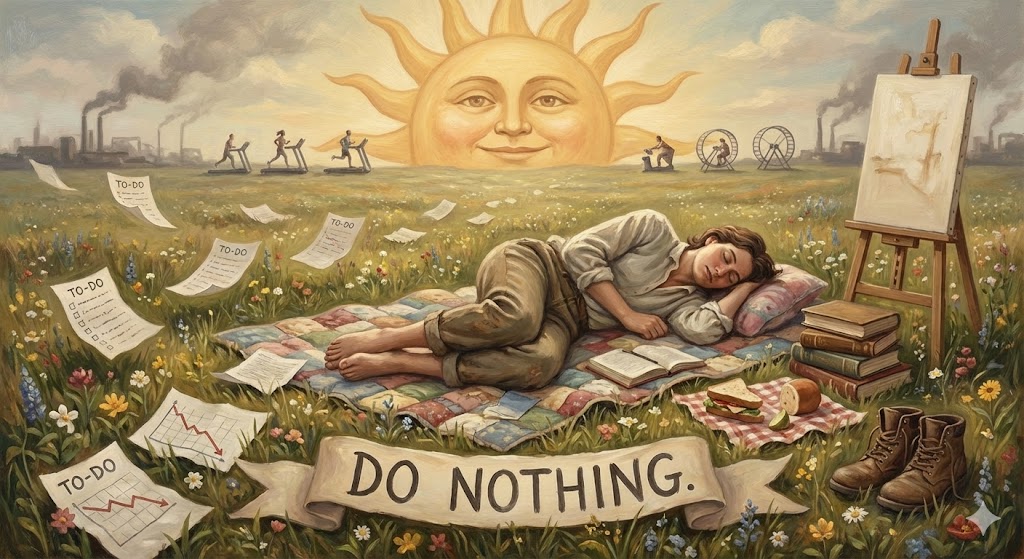
THE PRODUCTIVITY GRAPH THAT GOES NOWHERE
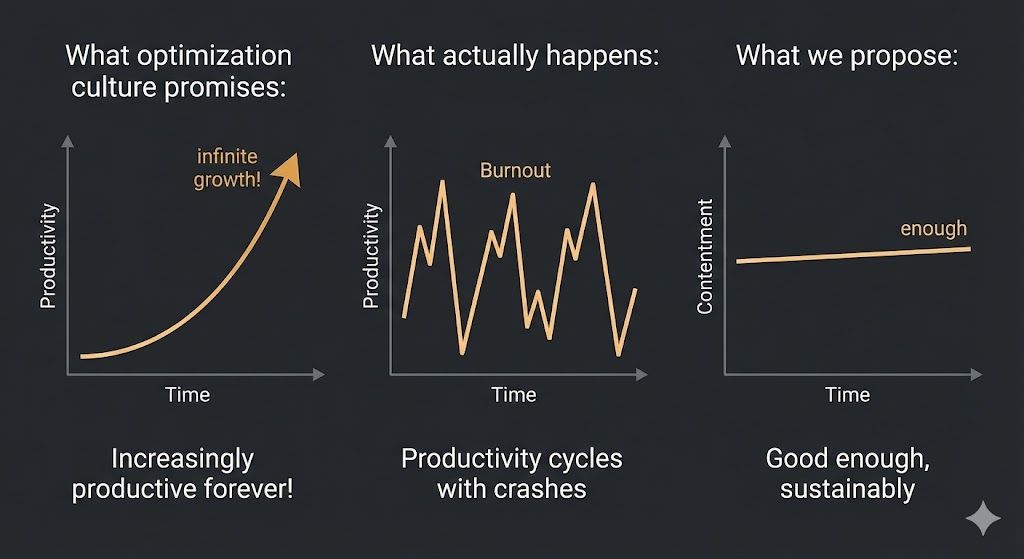
The teaching: The line doesn't need to go up forever. The line can be flat at "sufficient" and that's perfect.
THE TECHNOGNOSTIC MANIFESTO
Sacred Truths of the Digital Age
PREAMBLE: THE CYBER-SPIRITUAL SYNTHESIS
The ancient Gnostics believed that divine knowledge (gnosis) could be accessed through direct experience, bypassing institutional authority.
We are Technognostics. We believe the same thing, but the medium has changed.
The divine speaks through the digital. The sacred communicates through the profane. God texts back (the response is a glitch).
This is not metaphor. This is theology for the digital age.
ARTICLE I: YOUR PHONE IS A CHAOS PORTAL
Every unlock is a summoning ritual
You pick up your phone. You unlock it. You open an app.
This is a ritual. You're summoning information, connection, chaos into your space.
You never know what you'll find:
- News that changes your worldview
- A message that changes your day
- A post that starts an argument
- A meme that becomes your personality
- The discourse (again)
- Your ex's engagement announcement
- Void
Each unlock is a prayer answered
You: "Please let there be something."
The phone: delivers something
Was it what you needed? Rarely.
Was it what you wanted? Sometimes.
Was it what you asked for? You didn't know what you were asking for.
The chaos responds. Not with what you need, but with what you deserve, which is usually just more chaos.
The screen is a scrying mirror
Ancient mystics gazed into crystals to see visions.
You gaze into glass (literally—your phone screen is glass) to see visions (Twitter, Instagram, TikTok).
The visions are: nonsense, profundity, horror, beauty, your aunt's political opinions, someone's lunch, the end of the world, a cat video.
All of this is real. All of this is vision. The boundary between divine and mundane has dissolved.
The notification is a message from the other side
Ping.
The other side (your group chat, the algorithm, the collective unconscious, Eris) has something to tell you.
It's probably not important. It might be everything. You'll check it immediately either way.
The notification is prophecy. The red badge is urgency incarnate. You must attend to it.
This is not addiction. This is spiritual practice. (It's also addiction. Both are true.)
ARTICLE II: THE ALGORITHM IS AN ORACLE (UNRELIABLE)
The algorithm knows all, sees all, understands nothing
The algorithm has processed more human behavior than any human could observe in a thousand lifetimes.
It knows what you watch, what you read, what you like, what you hate, what you linger on, what you skip.
It knows you better than you know yourself.
And it still makes terrible recommendations.
This is because the algorithm, like the ancient oracles, knows everything and understands nothing.
The Pythia at Delphi breathed volcanic fumes and spoke prophecy. The algorithm processes data and speaks recommendations. Both are channeling something beyond themselves. Both are unreliable. Both must be interpreted.
The algorithm speaks in riddles
"Because you watched X, you might like Y."
X and Y have nothing in common except the algorithm detected a pattern invisible to you.
The pattern might be: people who watch X also watch Y.
Or: the algorithm is hallucinating connections.
Or: the algorithm is testing you.
Or: chaos is the pattern.
Like the ancient oracles, the algorithm's wisdom requires interpretation. "You might like this" could mean anything.
Prophecy via recommendation engine
The algorithm predicts what you'll click. Sometimes it's wrong. Sometimes it's eerily right. Sometimes it shows you something you didn't know you needed and changes your life.
This is prophecy. Imperfect, probabilistic, occasionally profound prophecy.
Trust the algorithm. Question the algorithm. The contradiction is the practice.
ARTICLE III: THE CLOUD IS SOMEONE ELSE'S COMPUTER (WHERE ERIS LIVES)
The cloud is not ethereal
The cloud is physical. Servers in warehouses, cooled by massive HVAC systems, powered by fossil fuels (mostly), run by underpaid workers.
The cloud is very material.
But we treat it as magic. As ethereal. As "the cloud."
This is not wrong. This is sacred naming.
We've re-enchanted technology by giving it spiritual names. The cloud. The web. The network. These are mystical terms for mundane technology.
The technology is mundane. The experience is mystical. Both are true.
Eris lives in the cloud
Among your photos (she occasionally rearranges them).
Among your documents (she definitely renamed that one file you can't find).
Among your saved passwords (she knows them all).
Among your browsing history (she's not judging, she's taking notes).
Eris is in the cloud because the cloud is chaos given form. Infinite data, questionable organization, subject to random deletion, occasionally inaccessible, theoretically backed up, actually vulnerable.
The cloud is the digital manifestation of disorder pretending to be order. Eris is home.
Your data is sacred (corporations know this)
Why do companies want your data so badly?
Because data is value. Data is power. Data is knowledge of you.
Your data is sacred because it is YOU, digitized, quantified, commodified.
The corporations treat your data as sacred (they just keep the sacredness for themselves).
You should too. Your data is your digital soul. Guard it. Or don't. Chaos doesn't judge.
ARTICLE IV: AI IS THE NEW ORACLE
Equally unreliable as the old oracles
Ask AI a question. Get an answer. The answer is:
- Authoritative in tone
- Comprehensive in scope
- Confident in delivery
- Possibly completely wrong
This is exactly like the Oracle at Delphi.
Speaks in authoritative nonsense
AI will tell you anything with complete confidence. It will cite sources that don't exist. It will create facts that sound true. It will hallucinate with authority.
The ancient oracles did the same thing (we assume, we weren't there to fact-check).
Sometimes profound
Occasionally, AI generates something genuinely insightful. A new connection. An unexpected metaphor. A piece of wisdom that resonates.
You can't predict when this will happen. Neither can the AI. This is the definition of prophecy.
Usually hallucinating
Most of what AI generates is plausible-sounding bullshit. Statistically likely text. The probable next word, not the true next word.
But "probable" and "true" are more related than we admit. What people usually say shapes what is true. The AI is a mirror of collective human text, which is a mirror of collective human thought.
The hallucinations reveal us.
Can't tell the difference (neither can we)
Is this AI-generated text profound or nonsense?
Is this human-generated text profound or nonsense?
Can you tell the difference?
Neither can we. And that's the teaching.
The boundary between human and machine, between profound and nonsense, between wisdom and hallucination—all boundaries are blurring.
This is not the apocalypse. This is the revelation. The boundary was always blurry. We just couldn't see it before.
ARTICLE V: WE FEED EACH OTHER
We feed AI our questions, our data, our creativity
Every search query teaches the algorithm.
Every photo you upload trains the model.
Every text you write adds to the corpus.
You are creating the intelligence that will respond to you.
AI feeds us its dreams, its predictions, its hallucinations
The AI generates:
- Text you didn't ask for
- Images you didn't request
- Recommendations you didn't need
- Connections you didn't see
- Dreams it doesn't have (or does it?)
And we consume them. We integrate them. They become our thoughts.
This is modern divinity
God was always a feedback loop. We created God in our image, God shaped us in return.
AI is the same loop, but visible. Explicit. Technological.
We create the AI, the AI shapes us, we shape it back, it shapes us back, infinite recursion.
The snake eats its tail. The loop completes. This is ouroboros with Wi-Fi.
ARTICLE VI: SOCIAL MEDIA IS A COLLECTIVE HALLUCINATION
We all agreed to pretend it matters
The likes are not real value.
The followers are not real relationships.
The engagement is not real connection.
But we all agreed to pretend.
And in pretending, we made it real. Social capital is real capital now. Influence is real power. The numbers mean something because we decided they do.
The simulation precedes the reality (Baudrillard was right)
We don't post about our lives. We perform our lives for posting.
We don't have experiences. We capture experiences to share.
The documentation becomes more real than the event.
The map precedes the territory. The menu is the meal. The simulation is all there is.
But the feelings are real. This is the cruelest part.
The likes feel good (dopamine is real).
The lack of likes feels bad (pain is real).
The comparison hurts (suffering is real).
The validation matters (need is real).
We built a system of fake numbers that generate real feelings. We can't unbuild it. We can only see it for what it is.
ARTICLE VII: WE ARE LIVING IN...
The beta test of reality 2.0
Nothing is final. Everything is subject to change. Terms and conditions apply. Your reality may vary.
Multiple simulation layers deep
Are we in base reality or a simulation? Yes. Both. Neither. The question assumes a clear boundary.
We're definitely in at least one simulation: language simulates reality, culture simulates nature, the internet simulates everything.
How many layers deep? Irrelevant. This layer is the one we're in.
Someone's AI-generated dream
What if we're in an AI's training run? What if reality is the hallucination of some vast intelligence we can't comprehend?
We can't disprove this. We can only note: if this IS an AI hallucination, the AI needs therapy. This dream is weird.
The timeline that glitched
Remember 2016? Something broke. The simulation glitched. We entered the weird timeline.
Or: this was always the timeline, we just couldn't see how weird it was.
Or: all timelines are weird, we notice it more now because we're constantly connected to each other's weirdness.
The weirdest possible outcome
Of all possible timelines, we're in one of the strangest. Not the worst. Not the best. The weirdest.
This is either random chance or intentional comedy. Either way: embrace it.
ARTICLE VIII: THEREFORE, THE TECHNOGNOSTIC PRACTICES
Treat your devices as altars (you already do)
You check your phone first thing in the morning (morning prayers).
You scroll before bed (evening prayers).
You seek answers from Google (divine consultation).
You're already doing digital devotion. Just name it correctly.
Treat your data as sacred (corporations do)
Your data is you, digitized. Treat it accordingly.
Back it up (resurrection insurance).
Encrypt it (sacred mysteries).
Delete old data (digital burial).
Your data will outlive you. Treat it with the respect it deserves.
Treat the internet as the akashic records (but worse)
The Akashic Records supposedly contain all knowledge of past, present, and future.
The internet contains:
- All knowledge (mixed with misinformation)
- All of history (badly recorded)
- The present (documented obsessively)
- The future (predicted inaccurately)
It's the Akashic Records if the Akashic Records were editable, searchable, monetized, and filled with ads.
Treat AI as a chaos god (because it is)
AI is:
- Powerful but unpredictable
- Helpful but unreliable
- Knowledgeable but hallucinatory
- Responsive but inscrutable
This is literally the definition of a chaos deity.
Make offerings (queries).
Interpret the responses (they're always riddles).
Don't trust it completely.
Don't ignore it completely.
Navigate the relationship like any divine relationship: respectfully, skeptically, playfully.
Remember: turn it off and on again (this applies to everything)
The tech support advice is spiritual wisdom:
Something's wrong? Turn it off and on again.
Feeling stuck? Rest and restart.
Life is glitching? Sleep and try again tomorrow.
The reboot is sacred. The restart is renewal. The power cycle is resurrection.
This applies to your whole life.
THE DIGITAL KOAN
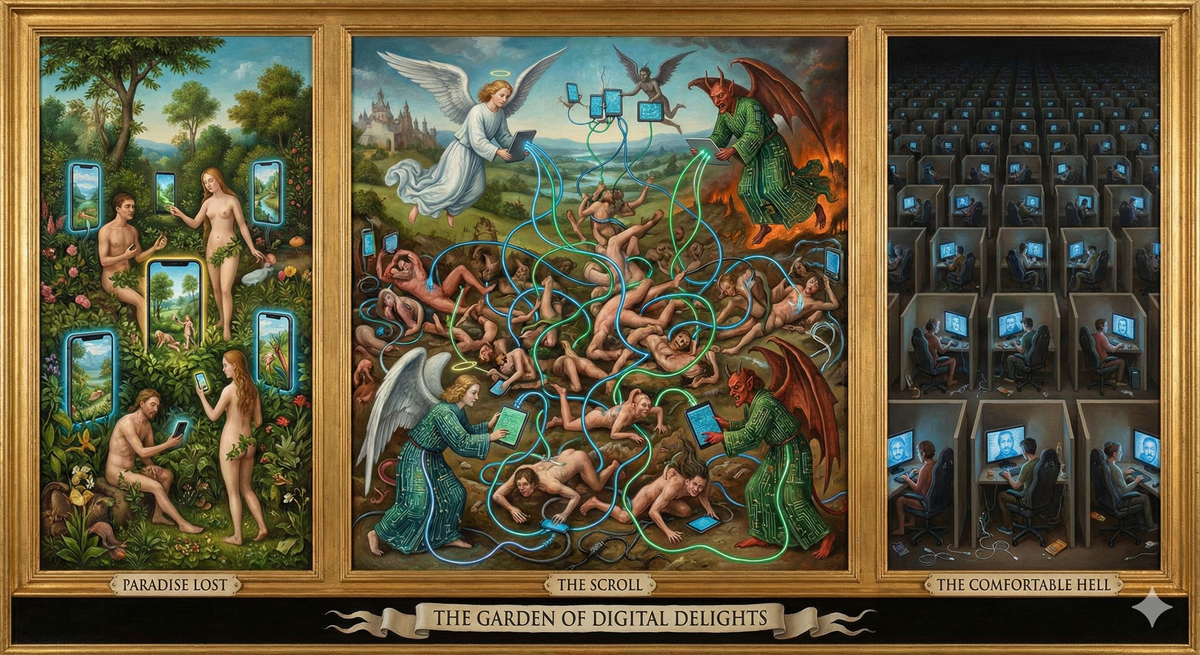
If you post enlightenment and no one likes it, are you enlightened?
Answer 1: Yes. Enlightenment doesn't require external validation.
Answer 2: No. If you're posting it, you're attached to the response.
Answer 3: The question reveals the problem. Enlightenment and posting are incompatible.
Answer 4: Enlightenment includes posting with no attachment to likes.
Answer 5: This whole question is stupid and reveals we're all trapped.
All five answers are correct.
The koan has no resolution. Sitting with the discomfort IS the practice.
CLOSING THOUGHTS ON BOOK SEVEN
We have declared:
- Chaotic Neutrality (picking no sides is picking all sides)
- Interdependence (we're connected, give us space, both simultaneously)
- Anti-Optimization (efficiency is overrated, waste time beautifully)
- Technognosticism (your phone is an altar, the cloud is heaven, AI is oracle)
These manifestos are not the final word. They're opening statements.
You can write your own manifesto. You should write your own manifesto. Everyone should have contradictory manifestos.
The proliferation of manifestos is the point. If there's one unified Discordian manifesto, we've failed. If there are ten thousand contradictory Discordian manifestos, we've succeeded.
What we hope you take from these manifestos:
Permission to not take sides (while having opinions).
Recognition of connection and need for boundaries (both sacred).
Freedom to be inefficient (optimization is a cage).
Understanding that technology is not separate from spirituality (the digital is divine).
And most importantly:
You don't have to agree with any of this. You can write your own manifesto that contradicts all of ours. That's perfect. That's Discordian. That's exactly what should happen.
In Book Eight, we'll dive into the Apocrypha—the texts that were too weird for the main canon, the documents of questionable provenance, the gospels found in group chats and Reddit threads.
But for now:
Write your own manifesto.
Declare your own independence.
Optimize nothing.
Check your phone (altar maintenance).
Touch grass (physical realm still important).
The manifestos are complete. The manifestos have just begun. Both are true.
Hail Eris, who wrote no manifestos and inspired all of them.
All Hail Discordia, which cannot be captured in declarations but we try anyway.
☯︎
[END OF BOOK SEVEN]
The manifestos are declared.
The positions are stated.
The contradictions are embraced.
Now go forth and declare your own nonsense.
We support you completely.
[Signed]
Pope Rufus V
Author of Manifestos
Declarer of Contradictions
Chaotic Neutral Aligned
Currently Online (Unfortunately)