Discordianism Decompiled · Book Nine · Chapter 6 of 8
Troubleshooting Your Spiritual Practice
When your chaos isn't working right
TROUBLESHOOTING YOUR SPIRITUAL PRACTICE
When your chaos isn't working right
Like any practice, Discordianism sometimes glitches. Here's how to debug common problems.
There's no right way to do this. The whole point is that there are infinite ways to do this, and they're all valid.
Unless there is a right way, in which case you're doing it right by doing it your way.
Actually, doing it wrong is doing it right, because chaos doesn't follow rules.
Stop overthinking this. (You won't stop overthinking it, that's fine too.)
The anxiety about doing it wrong is part of the practice. Notice the anxiety. Sit with it. Laugh at yourself for being anxious about doing chaos correctly.
That's the practice right there.
This is a common error. People read about Discordianism, get excited, and start taking chaos very seriously.
They create elaborate chaos systems. They study Discordian texts like scriptures. They debate fine points of theology with other Discordians.
All of this is taking it too seriously.
Take it less seriously. But not too un-seriously. There's a balance. The balance is chaos. You're overthinking the balance. See Problem #1.
HOW TO TAKE IT LESS SERIOUSLY:
- Laugh at yourself
- Laugh at this book
- Laugh at Eris
- Remember it started as a joke
- Remember the joke is also serious
- Remember you don't have to remember any of this
- Touch grass
- Do something completely unrelated to Discordianism
- Come back later and see if it's still fun
- If it's not fun, stop doing it
Not getting it is getting it. This is not a paradox meant to confuse you. This is a genuine teaching.
If you got it—if you understood it completely, if it all made perfect sense—you'd have missed it. You'd have turned it into something comprehensible, something that fits in your existing frameworks.
But Discordianism is designed not to fit. It's designed to confuse. It's designed to break your frameworks.
The confusion is the teaching. Understanding will arrive when you stop trying to understand. Or it won't. Both are fine.
You've started questioning things. You've started seeing patterns of order and disorder. You've started talking about chaos like it's divine. You've started explaining Discordianism to people who didn't ask.
People think you're weird. This is correct. You are being weird. Weird is excellent. Normal is suspect.
Embrace the weird. But also, social calibration is a thing. Don't be insufferable about your chaos. That's just regular annoying.
Good. Conflict means both beliefs are substantial enough to have boundaries. Conflict means you're taking both seriously. Conflict means you're in the productive zone of cognitive dissonance.
Hold both. Hold them simultaneously. Let them contradict. Don't rush to resolve the contradiction.
Cognitive dissonance is the practice. You contain multitudes. The conflict is productive. Synthesis happens in the tension. Or doesn't. That's also fine.
That's the good stuff. That's where the real work happens.
Crisis means change is coming. Change is chaos. Chaos is divine. You're in the right place.
Existential crises are uncomfortable, but they're also opportunities. They're moments when the rigid structures of your worldview are cracking open. Light gets in through the cracks.
You're not broken. You're transforming. It just feels like breaking because transformation is intense.
What to do: Breathe. Touch grass. Call a friend. Journal. Don't make major life decisions right now. Know that it gets better/worse/different—all three are accurate. The crisis will pass. Or it won't and you'll adapt. Either way, you'll be okay. Even if it doesn't feel that way now.
You've been practicing Discordianism. You've read the books, done the rituals, contemplated the koans. And... nothing has changed. Your life looks the same. You feel the same.
This is normal. Not everything needs to be dramatic.
Maybe change has happened and you haven't noticed. Maybe small things have shifted. Maybe your relationship to chaos has changed even if your circumstances haven't.
Or maybe nothing has changed and that's okay. Not every spiritual practice produces visible results. Sometimes the practice is just being more conscious. More present. More aware.
That's enough. That's everything.
- Are you less anxious about things being out of control?
- Do you laugh more at absurdity?
- Are you more comfortable with uncertainty?
- Do you question authority more?
- Are you kinder to yourself?
- Do you notice patterns you didn't see before?
Yes, this can happen. Chaos needs order to push against. Too much chaos is just noise. Too much disorder is exhausting.
If your life has become unmanageably chaotic—if you've lost all structure, if you're overwhelmed, if nothing is stable—you need to introduce some order.
This is not failure. This is balance. Eris is the goddess of chaos, but she exists in relationship to order. One without the other is meaningless.
- Create small routines
- Set gentle boundaries
- Make some plans (but keep them flexible)
- Organize one area of your life
- Pay your bills on time (radical, I know)
- Sleep regular hours
- Eat actual meals
- Think jazz, not marching band—structure with improvisation
- Order is not the enemy
- Rigid order is the enemy
- Flexible order is your friend
GENERAL TROUBLESHOOTING ADVICE
If none of these specific problems match yours:
- Take a break from Discordianism
- Touch grass
- Drink water
- Talk to a human
- Come back when you're ready
- Or don't come back
- Both are valid
Remember: this is supposed to help, not hurt. If it's not helping, stop doing it. No practice is mandatory. No belief is required.
You're okay. You're doing fine. The chaos loves you.
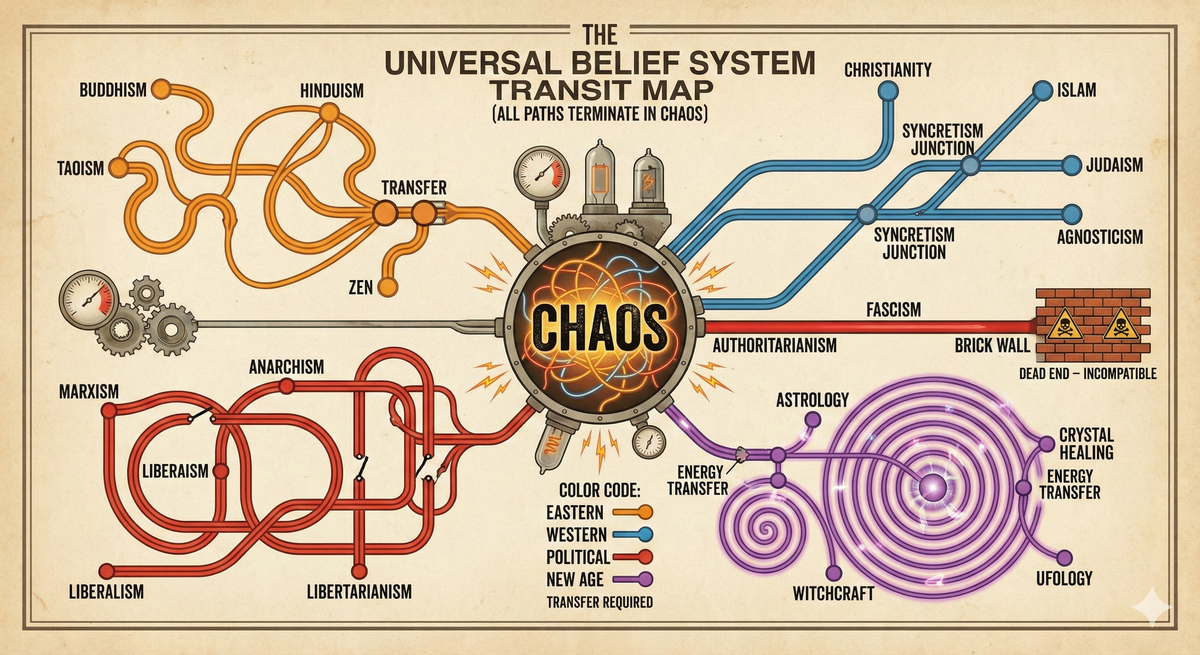
What works with Discordianism (everything) and what doesn't (very little)
One of the beautiful things about Discordianism is that it's compatible with almost everything. Chaos is universal. Disorder is ecumenical.
Here's what works with Discordianism and what doesn't.